2017年6月5日星期一

The world's fastest battery-powered NDIR CO2 sensor


The world's fastest battery-powered NDIR CO2 sensor

Gas Sensing Solutions (GSS) Ltd, the LED-based NDIR detector specialists, continues to push the boundaries for CO2 detectors with the launch of its new SprintIR6S.  GSS' unique SmartIR™technology has enabled it to create a sensor that can take up to 20 readings per second, which is a world record for NDIR CO2 detectors, and has a six times faster response rate than the SprintIR CO2 sensor*.
Ralph Weir, GSS' CEO, explained, "We are the only company producing CO2 sensors using LEDs and photodiodes and, as we make the LEDs and photodiodes ourselves, we have been able to develop ultra-fast response times that no other NDIR sensor can match.  Typical NDIR CO2 detectors take several seconds or even minutes to take a reading - because they use slow-reacting IR sources, which need time and energy to warm up, like MEMS hotplates, micro-bulbs or filament-based micro-lamp technologies. Our LEDs, by contrast, are Solid State emitters, and illuminate almost instantly.  With the new SprintIR6S, we've also minimized the sample volume down to only 2ml, which enables us to achieve our fastest ever response rates*.  This puts us in a unique position to open whole new application areas for CO2 monitors that could never be addressed by slow responding sensors based on traditional IR sources."
Applications for this new class of ultra fast CO2 sensors include health where they can capture rapidly changing CO2 concentrations in the breathing cycle to provide diagnostic information, which can be used in fitness testing, breath analysis/measurement, capnography, sports science and veterinary to name a few.  In Industrial Health and Safety applications, such as factories where CO2 is used for modified atmospheres to delay packaged food from spoiling, they can provide ultra fast detection of rising CO2 levels.  Even a doubling or tripling of normal CO2 levels can affect concentration and productivity with higher levels having increasingly deleterious effects on health right up to unconsciousness and death. 
"A leak from a CO2 canister or similar can push CO2 levels up from the normal 400ppm to several thousand ppm in seconds," added Ralph Weir.  "You cannot smell CO2 and it is colorless.  Yet it can present serious health problems at raised concentrations so, the sooner an alarm is raised, the sooner people can take remedial action.  For example, restaurants and pubs usually have CO2 cylinders in the basement for the drinks but basements typically have poor ventilation so an undetected CO2 leak could suddenly raise the CO2 level when someone was in the basement and render them unconscious - or dead.  Our new sensors can give the earliest possible warning."
GSS' multi-patented SmartIR™ technology detects the presence of CO2 by detecting how much light is absorbed by CO2 molecules as light passes through the sample gases - called Non-Dispersive InfraRed (NDIR) absorption.  CO2 absorbs between 4.2 and 4.4 microns so that its presence is easily detected, and the amount of light absorbed indicates how much CO2 is present. Typically, CO2 detectors use a miniature heater (such as MEMS devices like micro hotplates, microlamp/microbulb or filament heater) to generate a range of wavelengths that have to be filtered down to the wavelengths needed, which is wasteful and energy inefficient, especially as a lot of heat is produced.  By contrast, GSS developed the world's first commercial, mid-range IR LEDs that are specifically tuned to emit just at 4.2 to 4.4 microns, making them highly energy efficient.  As a result, GSS CO2 sensors are the only NDIR CO2 sensors that can be powered by batteries - a single lithium cell can power a SmartIR sensor for up to ten years.
At less than a cubic inch (23.8mm in diameter and 24mm tall), the SprintIR6S operates at between 3.25 and 5.5V, with a power consumption of only 35mW.  The SprintIR6S is available in measurement ranges from 0%to 100%.
GSS will be revealing the new SprintIR6S detectors at the Sensor + Test show in Nuremberg, Germany from 30 May to 1 June 2017.
High Speed Carbon Dioxide Sensor NDIR CO2 Sensor SprintIR Summary
SprintIR is a high speed (20 Hz) CO2 sensor, ideally suited for applications which require capture of rapidly changing CO2 concentrations including metabolic assessment and analytical instrumentation.

High Speed Carbon Dioxide Sensor NDIR CO2 Sensor 20Hz 0-100%

Fast, Accurate Carbon Dioxide Sensor
The SprintIR carbon dioxide sensor is the fastest, most accurate CO2 sensor on the market. A breakthrough in NDIR technology, the SprintIR uses advanced solid state Indium Antimonide LED’s and detectors to offer a robust sensor with no moving parts, no heated filaments, and incredibly low power requirements. The sensor comes in four versions - from 0% to 100% - all capable of the same high-speed CO2 measurement. This makes the SprintIR especially useful in biological applications.

• High speed sensing (20Hz)
• Measurement ranges from 0 to 100%
• 3.3V supply
• Low power requirement 35mW
• Flow through adaptor (Optional)


High Speed Carbon Dioxide Sensor NDIR CO2 Sensor Specifications
CO2 Measurement
Sensing Method Non-dispersive infrared (NDIR) absorption
Patented Gold-plated optics
Patented Solid-state source and detector
Sample Method Diffusion(Standard) / Flow through (with flow-through adapter)
Measurement Range 0-5%, 0-20%, 0-60%, 0-100%
Accuracy ±70 ppm +/- 5% of reading
Measurement Noise <10% of reading with no digital filtering
Non Linearity < 1% of FS
Pressure Dependence 0.1% of reading per mbar in normal atmospheric conditions
Operating Pressure Range 950 mbar to 10 bar
General Performance
Warm-up Time < 1 minute
Operating Conditions 0°C to 50°C (Standard)
-25°C to 55°C (Extended range)
0 to 95%, RH non-condensing
Recommended Storage -30°C to +70°C
Electrical/ Mechanical
Power Input 3.2 to 5V. (3.3V recommended)
Peak current 100mA
Average Current <15mA
Power Consumption 35 mW
Output UART only 


2017年3月16日星期四

HTF3223LF Humidity Sensor

HTF3223LF Humidity Sensor Module for Humidifier, OA Equipment

HTF3223LF Humidity Sensor Module for Humidifier, OA Equipment
Temperature and humidity sensor HTF3223L
1. range: 0-99%RH
2.Stable, linear proportional frequency output from 10 to 95

Product Specification

Temperature and humidity sensor module HTF3223
Description of humidity module HTF 3223LF
Based on the rugged HS1101LF humidity sensor, HTF 3223LF is a dedicated humidity and temperature transducer designed for OEM applications where a reliable and accurate measurement is needed. It features a miniature connector for easy, cost-effective mechanical mounting. Direct interface with a micro-controller is made possible with the module’s linear frequency output.

Main features of humidity module HTF 3223LF
(1)Calibrated within +/- 5% RH @ 55% RH.
(2)Optional 10 K +/- 3% NTC temperature sensor
(3)Fast response time. High resistance to chemicals.
(4)Size and connector type match existing humidity modules.
(5)Stable, linear proportional frequency output from 10 to 95% RH.
(6)Instantaneous de-saturation after long periods in saturation phase.
(7)Not affected by water immersion. Patented solid polymer structure.
(8)Stable characteristics with temperature. High reliability and long term stability.

2017年3月10日星期五

GUVA-S12SD UV Sensor

GUVA-S12SD UV Sensor

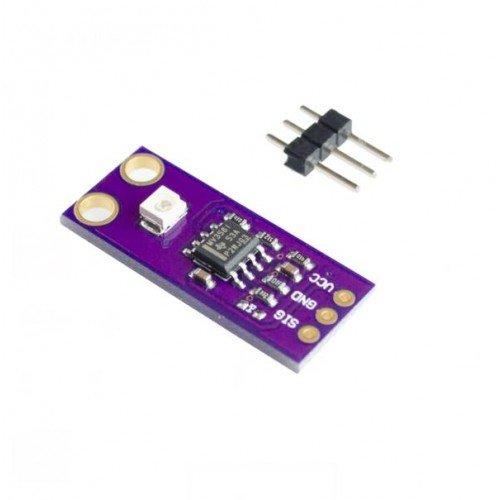
The GUVA-S12SD UV Sensor chip is suitable for detecting the UV radiation in sunlight. It can be used in any application where you want monitor for the amount of UV light and is simple to connect to any microcontroller. I recently noticed that some sellers had little modules for this sensor at a reasonable price so decided to purchase one
s12sd
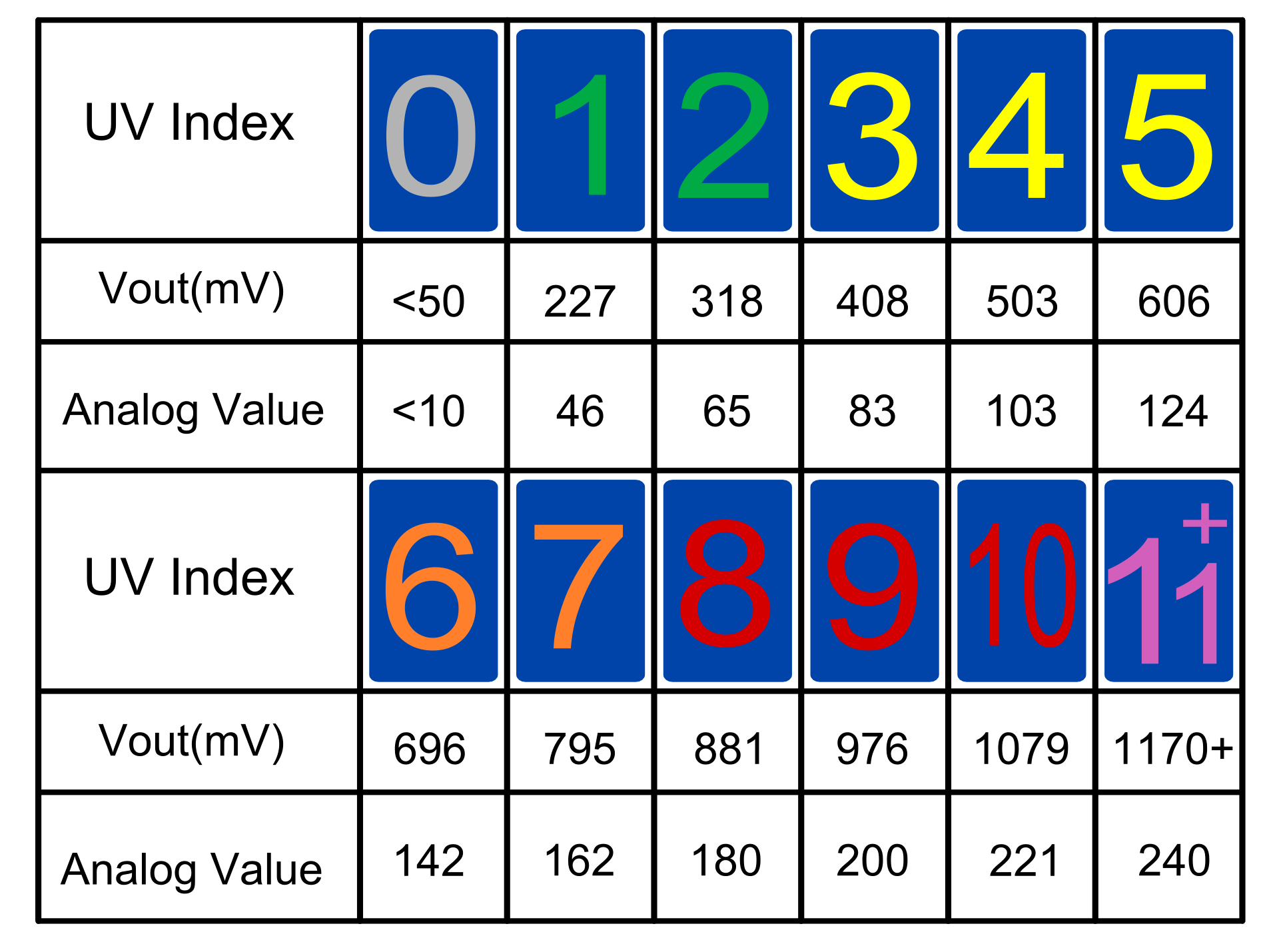
The module, with a typical UV detection wavelength of 200 – 370nm, outputs a calibrated analog voltage which varies with the UV light intensity so basically all you need to do is connect this to an ADC input and read in the value.
This value ties in with the UV index, this looks something like this
uv_index

Connection
The connections are straightforward and described below, I used 3.3v from my Arduino. This was mainly for compatibility with other development boards but the module works with 5v.
1. GND: 0V (Ground)
2. VCC: 3.3V to 5.5V
3. OUT: 0V to 1V ( 0 to 10 UV Index)
Layout
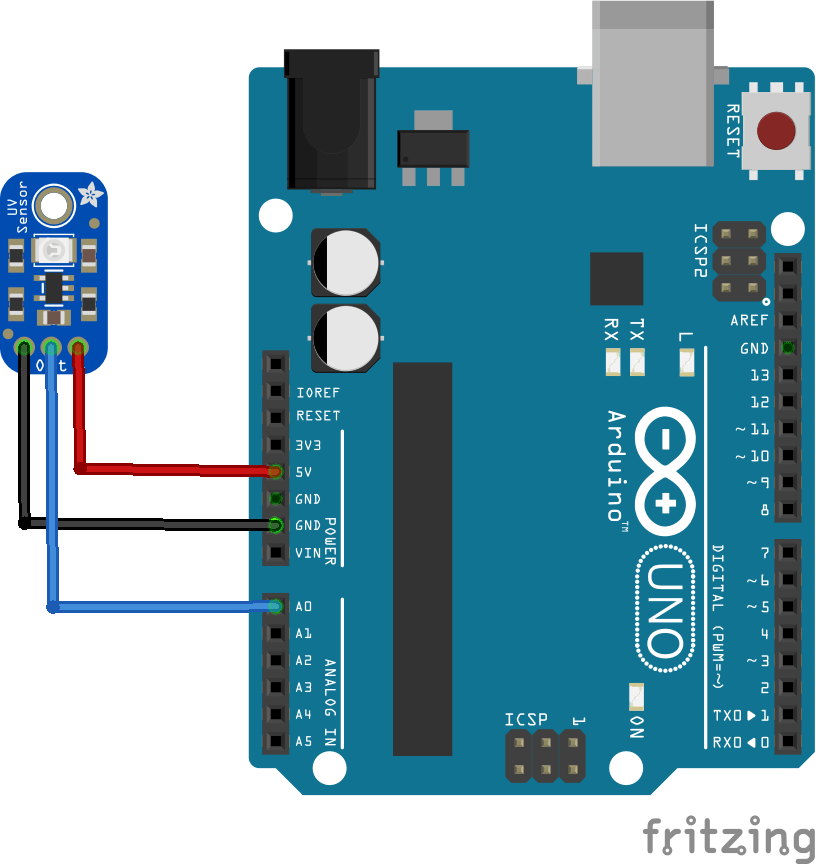
As said its a simple layout but here you go

arduino-and-guvas12sd_bb
Code
Simple code example that reads the value at A0 and outputs the results via the serial monitor, if you use 5v rather than 3.3v then you will need to change the 3.3 in the following line
sensorVoltage = sensorValue/1024*3.3;    
Source code  
void setup()   {    Serial.begin(9600);  }     void loop()   {    float sensorVoltage;     float sensorValue;       sensorValue = analogRead(A0);    sensorVoltage = sensorValue/1024*3.3;    Serial.print("sensor reading = ");    Serial.print(sensorValue);    Serial.println("");    Serial.print("sensor voltage = ");    Serial.print(sensorVoltage);    Serial.println(" V");    delay(1000);  }
Testing
Open the serial monitor and look at the readings
sensor reading = 46.00
sensor voltage = 0.15 V
sensor reading = 46.00
sensor voltage = 0.15 V
sensor reading = 46.00
sensor voltage = 0.15 V
sensor reading = 46.00
sensor voltage = 0.15 V
sensor reading = 46.00
sensor voltage = 0.15 V
If you look at the image earlier that corresponds to UV index of 0 which is a relief because I tested this indoors

UV-A Sensor - GUVA-S12SD

Product Specification

1.Features
Gallium Nitride Based Material
Schottky-type Photodiode
Photovoltaic Mode Operation
Good Visible Blindness
High Responsivity & Low Dark Current

2.Applications
UV Index Monitoring
UV-A Lamp Monitoring

3.Outline Diagrams and Dimensions


4.Details


2017年3月6日星期一

CO2 Sensor Occupancy Detection


CO2 Sensor Occupancy Detection

A group of researchers at the University of California in Berkley have designed an algorithm that can count the number of people in a room when only the CO2 level is known.
The study, titled “Sensing by Proxy: Occupancy Detection Based on Indoor CO2 Concentration” used SenseAir’s K-30 carbon dioxide sensor module for occupancy detection. The "Sensing by Proxy" model is more accurate than previously used machine learning models, and could be used to improve the efficiency of Demand-Controlled Ventilation systems (DCV) currently in use.
DCV works on the principle that you can save energy by heating, cooling or adding fresh air to a room only when it is needed. While heating and cooling can be controlled with a thermostat, the amount of fresh air that should be added to a room can be controlled by a carbon dioxide level transmitter. When CO2 levels go up, fresh air is added until the CO2 levels return to normal (typically 10% or less of the background CO2 levels).
NDIR CO2 Sensor Infrared CO2 Sensor module 0~10000PPM
While CO2 transmitters in a DCV system are good at monitoring CO2 levels, they do not tell you the number of occupants in a room. This is important because indoor air quality models specify the optimum fresh air exchange rate per person. If you don’t know how many people are in a room, all the system can do is pump in fresh air until the CO2 level drops.
This is where Sensing by Proxy comes in. Using the K-30 sensor’s CO2 level data as the only input, the researchers were able to create a model “that captures the spatial and temporal features of the system and links unobserved human emission to proxy measurements of CO2 concentrations.”
The algorithm they developed was tested in both controlled and field experiments, and resulted in an error rate of 0.6 fractional persons as compared to 1.2 fractional persons by the best alternative strategy. The algorithm is also better at measuring changes, such as occupants entering and leaving a meeting. In addition, it does not require more costly Pyroelectric infrared (PIR) or Ultrasonic sensors used for current occupancy detection systems.
The algorithm is one of a growing number of papers that test the use of CO2 levels for occupancy detection. For example, Chaoyang Jiang and others in a paper titled “Indoor occupancy estimation from carbon dioxide” were able to estimate occupancy in an office with 24 cubicles. They counted occupants accurately 94 percent of the time within a tolerance of four occupants.
While DCV is initially more expensive to install, improvements like this could be used to further reduce the long-term energy costs in DCV controlled buildings.

2017年2月21日星期二

UV Sensor Module - GUVB-T21GH

UV Sensor Module - GUVB-T21GH

- Chip size 0.4mm,TO 5 PKG
- Single Supply Voltage Operation
- Voltage Output
- High Sensitivity and Good Solar Blindness
- Small and Compact Size

UV Sensor Module

Product Specification


2017年2月17日星期五

UV-A Sensor - GUVV-S10SD

UV-A Sensor - GUVV-S10SD

-Chip size 0.4mm,SMD 3528 PKG,
-Indium Gallium Nitride Based Material
-Schottky-type Photodiode
-Photovoltaic Mode Operation
-High Responsivity & Low Dark Current
UV-A Sensor

Product Specification

1.Features

Indium Gallium Nitride Based  Material
Schottky-type Photodiode
Photovoltaic Mode Operation
High Responsivity & Low Dark Curren

2.Applications
UV-A Lamp Monitoring

3.Outline Diagrams and Dimensions


4.Details


5.Graph


more products visit: UV Sensors